

Scaly-Naped Pigeon
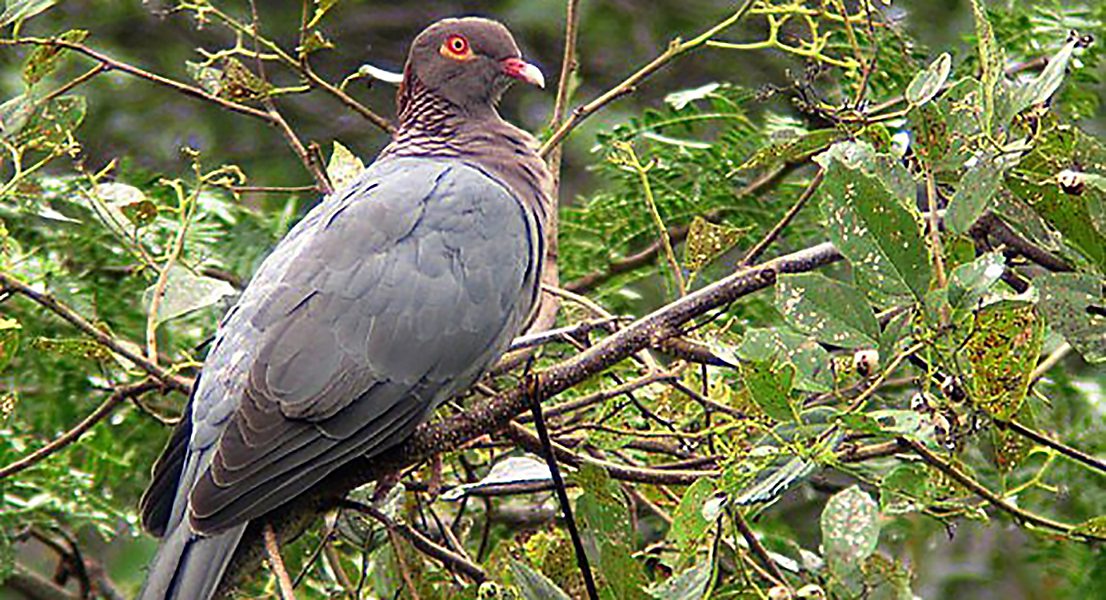
The Scaly-naped Pigeon is common and widespread throughout the Caribbean except for Jamaica and the Bahamas, where it does not occur. This species is large and distinctive within its range, showing purple-red plumage, with pale buff scaly edges to the nape feathers. The Scaly-naped Pigeon is common throughout a variety of forested habitats at most elevations. It is generally most common in intact primary lowland and montane forest, but can be seen along a variety of forest edge and secondary forest types.
General Information
Range
Habitat
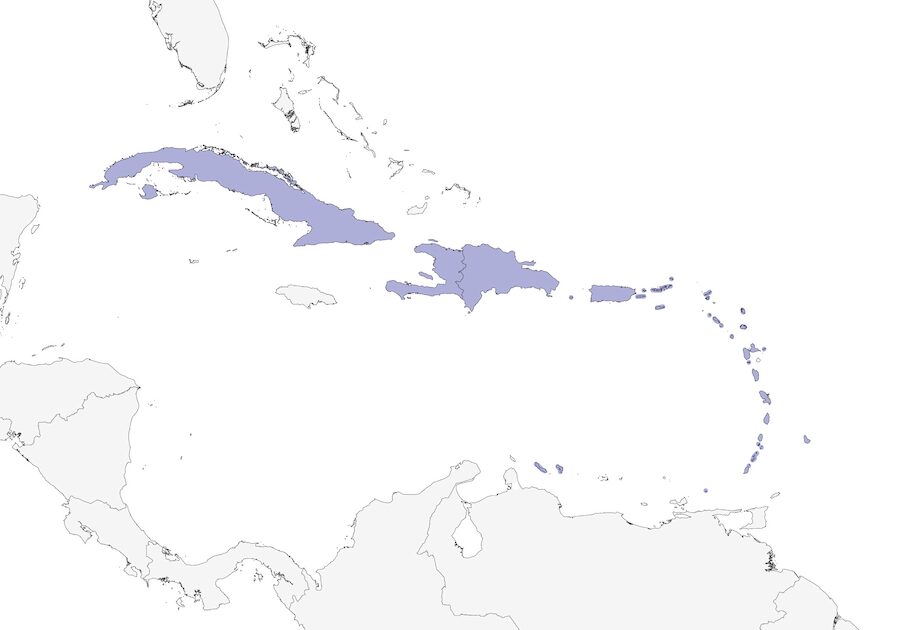
They are found in Greater Antilles (except Jamaica) and Lesser Antilles; also Curaçao and Bonaire, and Los Testigos (off north east Venezuela). They are found in humid highlands, especially in rainforest, but may descend to arid lowlands on Barbados and elsewhere. You may also find them in the city.
Food
These birds enjoy various fruits, berries, buds, succulent leaves and small snails; seeds are digested along with the fruit. In Puerto Rico, they feed on berries of various palms, wild legumes, wild figs, moral (Cordia) and jaqua (Genipa americana).
Behavior
They seem to make calls regarding the availability of food, especially fruits like apple rose (Syzygium jambos). Their song is a rhythmic series of low-pitched coos, typically starting with a long monotonous note followed by triple notes repeated: “whooo…pu-whu-whuh…pu-whu-whuh..pu-whu-whuh…”, sometimes with a hoarse quality or shortened to “whooo…pu-whu…pu-whu…pu-whu…”. Call is a low-pitched burry “rhurrrrrrr”.
Nesting
They breed year-round on some islands, but principally Mar–Jun on Hispaniola and in Cuba. Their nests are usually in a tree, sometimes in shrubs or palms or bromeliads, or in hole or crevice in rocky cliff, up to 5 m above ground. In Netherlands Antilles, their nests may be in Rhizophora and Avicennia mangroves. They are sometimes reported to breed on ground itself on uninhabited islands. Their clutches are 1–2 white eggs.
How to Identify
Appearance
Size & Shape
These pigeons are approximately between 33 and 40 cm tall, weighing betweel 250–360 g.
Color Pattern
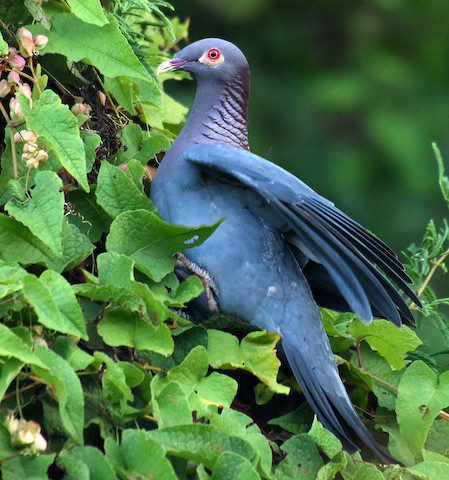
The upper neck and breast are purple-brown with the wine-colored back of the neck (i.e. the nape) forming a beautiful shield of feathers, resembling scales and easily one of the bird’s most identifiable features. Their feet are similar in color to their scaly napes. The rest of the body is a metallic, purple-tinted gray color. Finally, their red eyes are deep and distinctive on top of tan-yellow skin beneath. Females are similar to males but duller in color. Juveniles have feathers fringed with buff; purple and wine red areas of adult are reddish brown, while grey areas are replaced with brownish slate.
Plumage Photos
© Steven Mlodinow / Macaulay Library
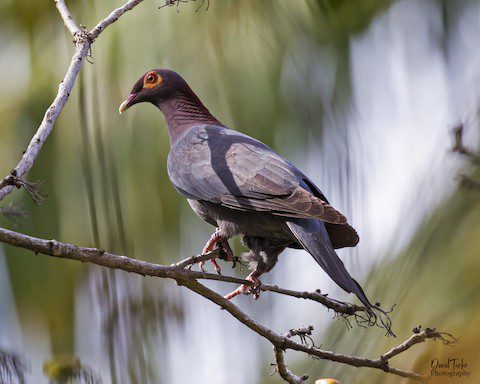
© David Turko / Macaulay Library
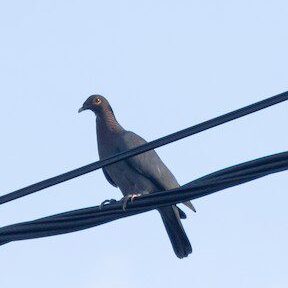
© Jessica Gallipeau / Macaulay Library
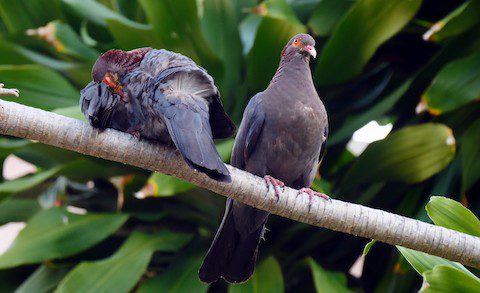
© Josep del Hoyo / Macaulay Library
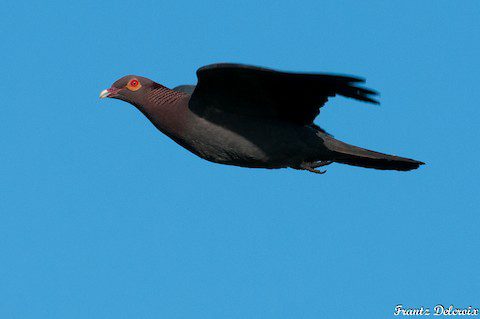
© Frantz Delcroix / Macaulay Library
Similar Species
Visually similar to other pigeons and doves, the Scaly-Naped Pigeon can be identified by its distinctively scaly neck and their red eyes.
Fun Facts
Did you know?!
- Although the Scaly-Naped Pigeon is not globally threatened (Least Concern), it is presumably extinct on Aruba (Netherlands Antilles), where a sighting was last reported in 1930. Later on, however, two sightings were reported in 1973… Also, it is very scarce in Curaçao, where it occurs in hills west of the populated area, and also in extreme east.