

Greater Antillean Grackle
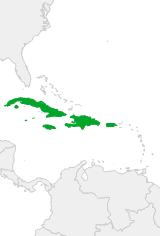
As its name suggests, the Greater Antillean Grackle is almost confined to the Greater Antilles, where it occurs on all four main islands, Cuba, Jamaica, Hispaniola, and Puerto Rico, in addition to the Caymans. Seven subspecies are generally recognized across this range, each restricted to one island or island group, and they typically differ in the extent and color of the glossy tones to the plumage. These are noisy, bold birds, confident around humans, and can make themselves at home in even the most disturbed habitats.
General Information
Range
Habitat
The Greater Antillean Grackle can be found in mangroves, marshes, savanna, coconut plantations, open fields, agricultural land, light woodland, and parks and gardens. You will find that they often roost in towns and cities. The nominate subspecies is mostly found below 1000 m, sometimes up to 2200 m; crassirostris is mostly found in lowlands.
Food
These omnivorous birds feed on wild and cultivated seed, including those of maize and rice, as well as insects and other arthropods as well as Anolis lizards and other vertebrates. They can even be found enjoying medium-sized Jamaican anole (Anolis grahami), and eggs and chicks of small birds, including the Banaquit (Coereba flaveola), grassquits (Tiaris) and Common Ground-dove (Columbina passerina); they also eat fruits of Bursera simaruba.
Behavior
While foraging for food, this Grackle species often goes in flocks up to several thousand birds in communal roosts. They often probe into ground and grass roots in search of arthropod prey. Also, they are not migratory birds; local movements to areas with fruiting trees reported from Jamaica is the extent of their movement away from home.
Nesting
Their nests are cup-shaped, made from plant materials including grass and Spanish moss (Tillandsia), reinforced with mud and lined with fine fibres, at variable height (in Cuba 5–16 m) above ground in tree, usually mangrove or palms (Rostoynea, Cocos, etc.). Each nest normally has 3–4 eggs, which are pale olive-colored with brown to black spots and scrawls. The males seem to feed the chicks, and the nestling period has been observed to last at least 23 days. Their nesting season runs from February to September, mainly April to July/August (March to July in Cuba). Their mating system not well known, but we do know that they are colonial breeders whose mangroves largest colonies are up to around 30 nests.
How to Identify
Appearance
Size and Shape
These birds are 25–30 cm in size. Their weights vary depending on their subspecies, but the average male weight is greater than the females. For Greater Antillean Grackles in Cuba, the average male is 86·6–100 g and female 60–72·5 g; male 67·5–88 g and female 51–64 g (caymanensis subspecies); male mean 112 g and female 79·3 g (crassirostris); male mean 86·4 g and female 61·7 g (brachypterus). The males typically have long and wedge-shaped tails.
Color Pattern
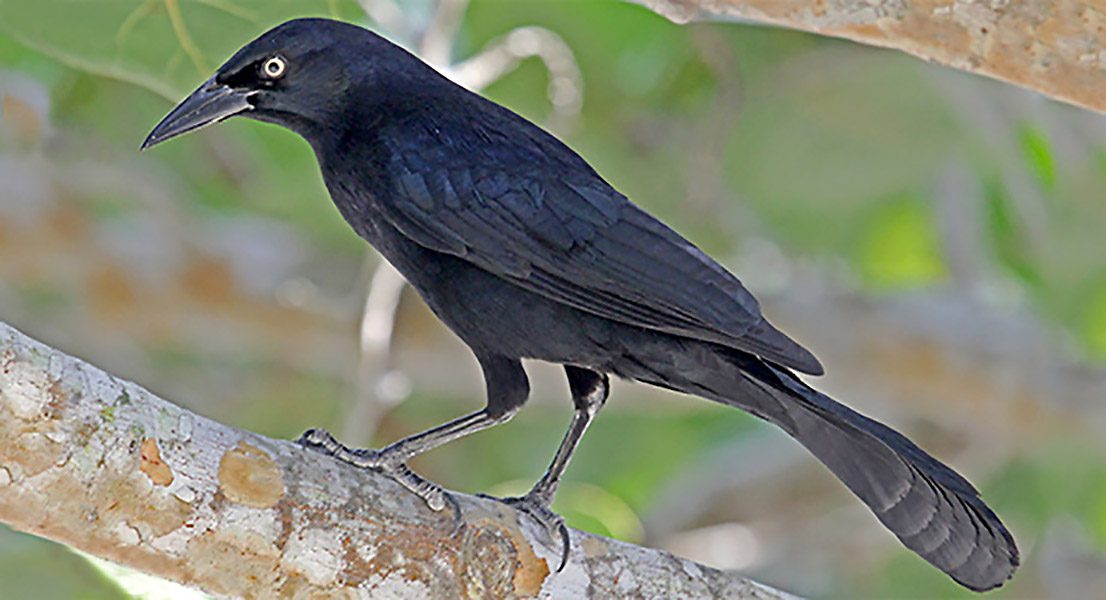
The male is typically entirely black, with strong purple gloss on his head and upperparts, and greenish gloss on flight-feathers and tail. The female resembles male, but smaller, less glossy, and with smaller tail not held in wedge-shape. Juvenile is brownish-black and has dark brown eyes. The subspecies or “races” differ mainly in size and color with the nominate or most common one being the smallest and having the most extensive purplish gloss.
Similar Species
There are four grackle species commonly found in North America, and they can be told apart by their size, shape, and tail patterns. The Great-Tailed Grackle and Boat-Tailed Grackle often look more slender and similar in appearance. Actually, Great-tailed and Boat-tailed are more closely related, and were once thought to represent the same species. Visually, the two can best be told apart by their eye color; Great-tailed has yellow eyes, Boat-tailed has dark eyes. Common Grackles are the smallest with shorter tails and smaller bills.
Fun Facts
Did you know?!
- Their song varies considerably among islands, but, for a grackle, it is relatively musical: a metallic “cling-cling-cling” and flute-like whistles. Their call sounds like “chuk” or “chuk-chuk” or “chin-chin-chilin”; also high “wee-si-si” and harsh notes.
- This species has been reported as a host of Molothrus bonariensis in Puerto Rico… luckily, experiments there showed that females eject most parasite eggs from nests!